Image
lang_switcher
Image
Language Switcher

Built for Uncertainty: Why Warehouses Need Flexibility Beyond Peak Seasons

Favorite
Built for Uncertainty: Why Warehouses Need Flexibility Beyond Peak Seasons

Every November, shopping events such as Black Friday, Cyber Monday and Double 11 push warehouses around the world to their limits. Orders spike, cut-off times tighten and every weakness in an operation shows up at once.

Peak defines the high-water mark: the demand threshold a warehouse must be capable of handling.

That peak becomes the guardrail for the design. The challenge is to create an operation today that can flex and adapt efficiently as demand grows, while preserving the capacity to reach that high-water mark when required.

Our experts see that flexibility and agility as fundamental to good warehouse design. In this edition of The Hai Perspective, we bring together three voices from three regions: Adrian Stoch, CEO of Hai Robotics Americas; Jack Grimley, Key Account Sales Director for EMEA; and Jon Guo, Product Marketing Manager for Greater China. Whether the peak is Black Friday in the US, Singles' Day in China or the weeks-long 618 festival, their view is consistent: the strongest operations can reach their peak when it comes, and run efficiently every other week of the year.

Peak is no longer a single day
Peak is no longer a single day

Not long ago, peak meant one surge at the end of the year, and the answer was people. Adrian remembers it well from his time at Target:


1
2

"When I joined Target 10 years ago, peak was largely a labor-ramp exercise. Across 30 warehouses, we would hire hundreds of people in a matter of weeks, absorb the inevitable training and productivity losses, employ them for two or three months, and then let them go in January. It was expensive, inefficient, and operationally disruptive."


— Adrian Stoch, CEO, Hai Robotics Americas

That model no longer holds. "Peak is no longer just one holiday surge that can be solved by throwing temporary labor at it," Adrian says. "Retailers face multiple peaks throughout the year, while customer expectations for speed and reliability have continued to rise."

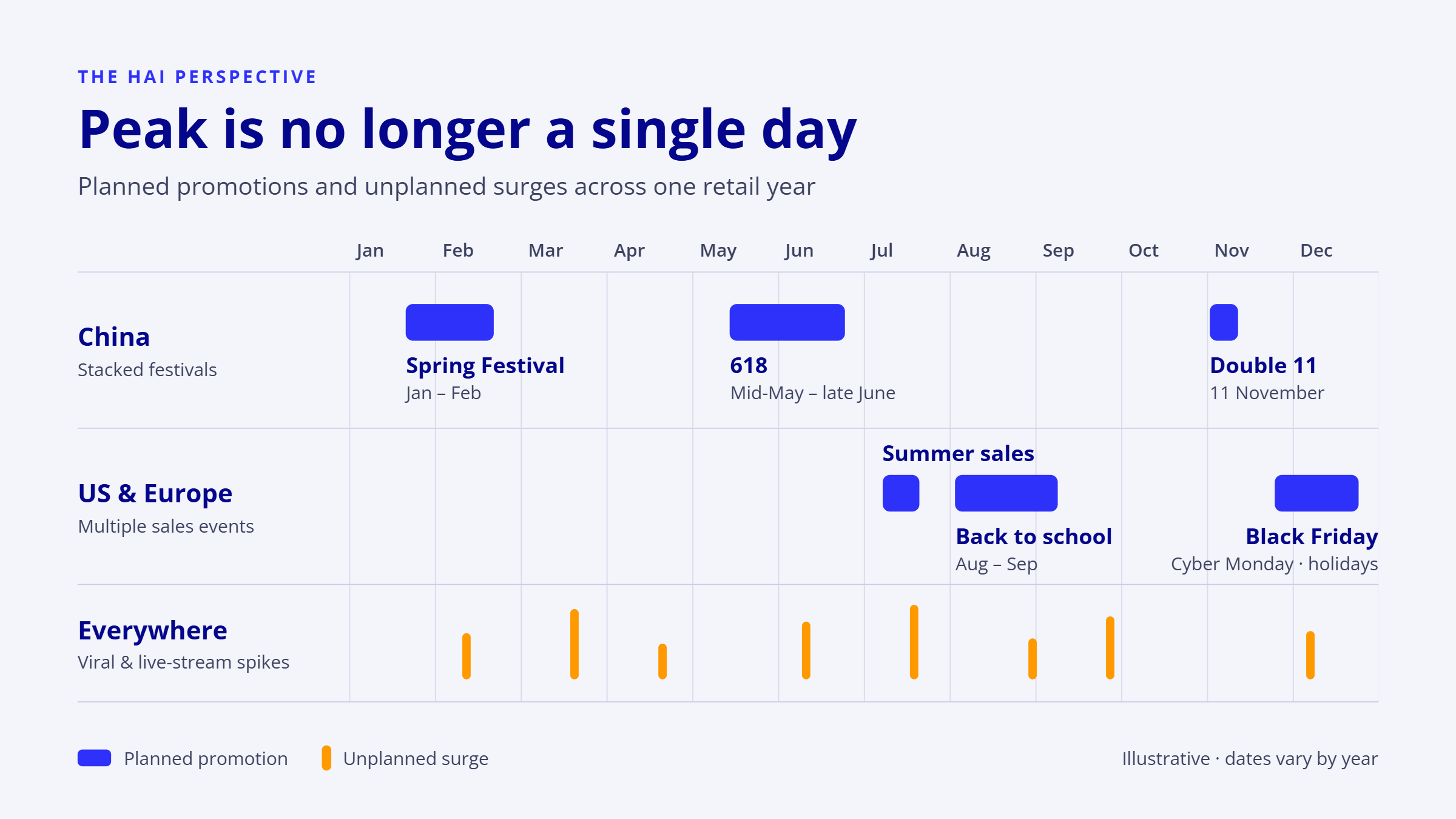
In China, this shift has gone even further. Jon describes a calendar where peaks are stacked on top of each other: Spring Festival shopping sprees, 618, Double 11 (Singles' Day on 11 November), plus sudden surges driven by live-streaming e-commerce. Promotions are stretching, too. 618 now runs from mid-May to late June, more than half a month of sustained pressure.

The speed expected inside those peaks is rising at the same time. "Delivery expectations are measured in hours, not days," Jon explains. "In Tier 1 and Tier 2 cities, next-day delivery has become the baseline, not a differentiator. Instant retail is even more demanding, requiring delivery within 30 minutes."

For Adrian, this changes how automation should be judged:

1
1

"Leading retailers increasingly recognize that automation cannot be justified solely through a traditional labor-ROI calculation. The ability to flex capacity, absorb multiple peaks, maintain productivity, and deliver consistently without repeatedly rebuilding the workforce has become a competitive necessity. In many operations, automation is no longer simply a cost-reduction decision — it is table stakes."


— Adrian Stoch, CEO, Hai Robotics Americas

Ready for every peak, efficient all year

Designing to the high-water mark does not mean running at it every day. When the full peak is built into the hardware from the start, the rest of the year pays for it. Jack sees the consequences across EMEA:

1
1

"I've walked plenty of sites in February where half the automation is sitting still. It was overspecified for peaks, and for the rest of the year its capital investment [was] not working for the business. That's the real cost of designing for peak: a system that looks right for six weeks and wrong for the other forty-six."


— Jack Grimley, Key Account Sales Director EMEA, Hai Robotics

His answer is to separate the capacity a site must be able to reach from the capacity it runs day to day. "My view is simple. You have to design with all 12 months in mind," he says.

In practice, that flex comes from operational levers rather than extra equipment. "Pull out your key sale lines and give them their own flow," Jack says. "Use batching and different picking nodes to lift throughput without adding more kit."

The other lever is preparation. Jack's advice is to work closely with supply chain and commercial teams well ahead of each peak and get the automation ready for it: pre-position stock, re-slot fast movers and stage whatever can be staged. "Peak then becomes a stretch for the system," he says, "not a reason to oversize it."

That preparation covers the peaks everyone can see coming. For everything else, the operation has to be able to respond.

Designing for flexibility, agility and uncertainty

For Adrian, the goal is not simply to accommodate change. It is to be ready for what nobody can predict:

1
1

"I would frame it less as being 'designed for change' and more as being designed for flexibility, agility and, ultimately, uncertainty. Forecasts are imperfect, and retailers are increasingly affected by forces outside their control — geopolitical disruption, tariffs, supply constraints, changing consumer behavior, social media and even individual influencers."


— Adrian Stoch, CEO, Hai Robotics Americas

He has seen how fast that uncertainty can hit. At GXO, a global cosmetics customer was preparing to discontinue a make-up product. Then a single customer posted a complaint about it on TikTok. The video went viral, and almost overnight the product went from being discontinued to becoming one of the brand's biggest sellers of the year. The operation had to respond immediately.

For Adrian, true omnichannel is one of the biggest enablers of that kind of response. Instead of separate inventory, capacity and infrastructure for each channel, retailers can plan around total demand and allocate stock and fulfilment capacity to whichever channel needs it. That "reduces the risk of having capacity or inventory trapped in the wrong place when demand shifts."

Jon defines the same principle from the system side. A truly flexible warehouse is not simply one that scales; many systems can scale. "It is one that bends to the customer's next move without rebuilding the building," he says. No site reconstruction should be required to absorb a new SKU mix, channel or volume level.

He points to Hai Robotics customer ANTA as an example. During peak business periods, the sportswear brand moves robots between warehouses to ramp up capacity quickly where it is needed. The capacity follows the demand, not the other way around.

Adrian sums it up:

1
2

"You cannot predict every disruption or demand spike, so you have to design for the ability to respond to them. The competitive advantage isn't having the perfect forecast. It's having a supply chain that doesn't require the forecast to be perfect."


— Adrian Stoch, CEO, Hai Robotics Americas

Designing for the whole year

The US, EMEA and China each live peak differently, but our experts arrive at the same conclusion. Peak still sets the bar, today and five years from now. But peak is no longer one weekend, demand no longer follows the forecast, and capacity that only earns its keep on the busiest day spends most of the year underused.

The operations that win are built differently:

  • Designed to the five-year high-water mark, with the ability to reach it when required instead of carrying idle capacity every day.

  • Able to flex through shifts, dedicated flows, batching and early planning with commercial teams.

  • Able to move capacity where it is needed, without rebuilding the site.

  • Planned around total demand, so inventory and capacity are never trapped in the wrong channel.

This November, Double 11 in China and Black Friday and Cyber Monday in the West will test warehouses again, with the next big promotion never far behind. Getting through one peak is no longer the measure of success. The real test is being ready for whatever comes next: the next shopping event, the next viral product, the next shift in demand nobody saw coming.

About the experts

Adrian Stoch is CEO of Hai Robotics Americas. He brings more than 20 years of supply chain leadership, including roles as Chief Automation Officer and Division President, Consumer, at GXO Logistics, Group Vice President, Global Supply Chain at Target, and senior operations roles at Teva Pharmaceuticals and Catalent Pharma Solutions.


Jack Grimley is Key Account Sales Director EMEA at Hai Robotics, where he focuses on driving strategic expansion in the European e-commerce and retail sectors. Before joining Hai Robotics, he spent nearly ten years at Ocado Intelligent Automation, in roles spanning warehouse solution design, business development and European sales for ASRS and AMR solutions.


Jon Guo is Product Marketing Manager Greater China at Hai Robotics. With years of experience in the warehouse automation sector, he focuses on how automation helps e-commerce and retail operations in Greater China keep pace with multi-peak promotions, live-stream sales and ever-faster delivery expectations.


Ready to build for every peak, not just the next one?

We work with warehouse and distribution operators across the Americas, EMEA and Asia to design automation that flexes with demand all year round, from Black Friday to Double 11 and every surprise in between.

1
1

微信扫码分享